
 Ayesha Malik
When I teach the laws of war to my undergraduate class, I do an exercise where I ask them to categorise situations into lawful ruses of war and illegal acts of treachery. We go through a few; what is camouflaging a military aircraft assembly plant so it looks like a civilian building? (a ruse), what is a soldier pretending to be wounded so he can shoot at an enemy soldier coming to assist him? (treachery), what is telling enemy troops over a loudspeaker to surrender because they are surrounded by larger forces when they’re not? (a ruse), what is putting up the white flag while lying in wait to ambush the other party? (treachery), and so on.
The law asks us to differentiate between the two; ruses involve subterfuge based on trickery and are allowed in war, whereas treachery (or perfidy) involves betrayal of a protected status for the purpose of causing harm which goes against notions of honor or chivalry.
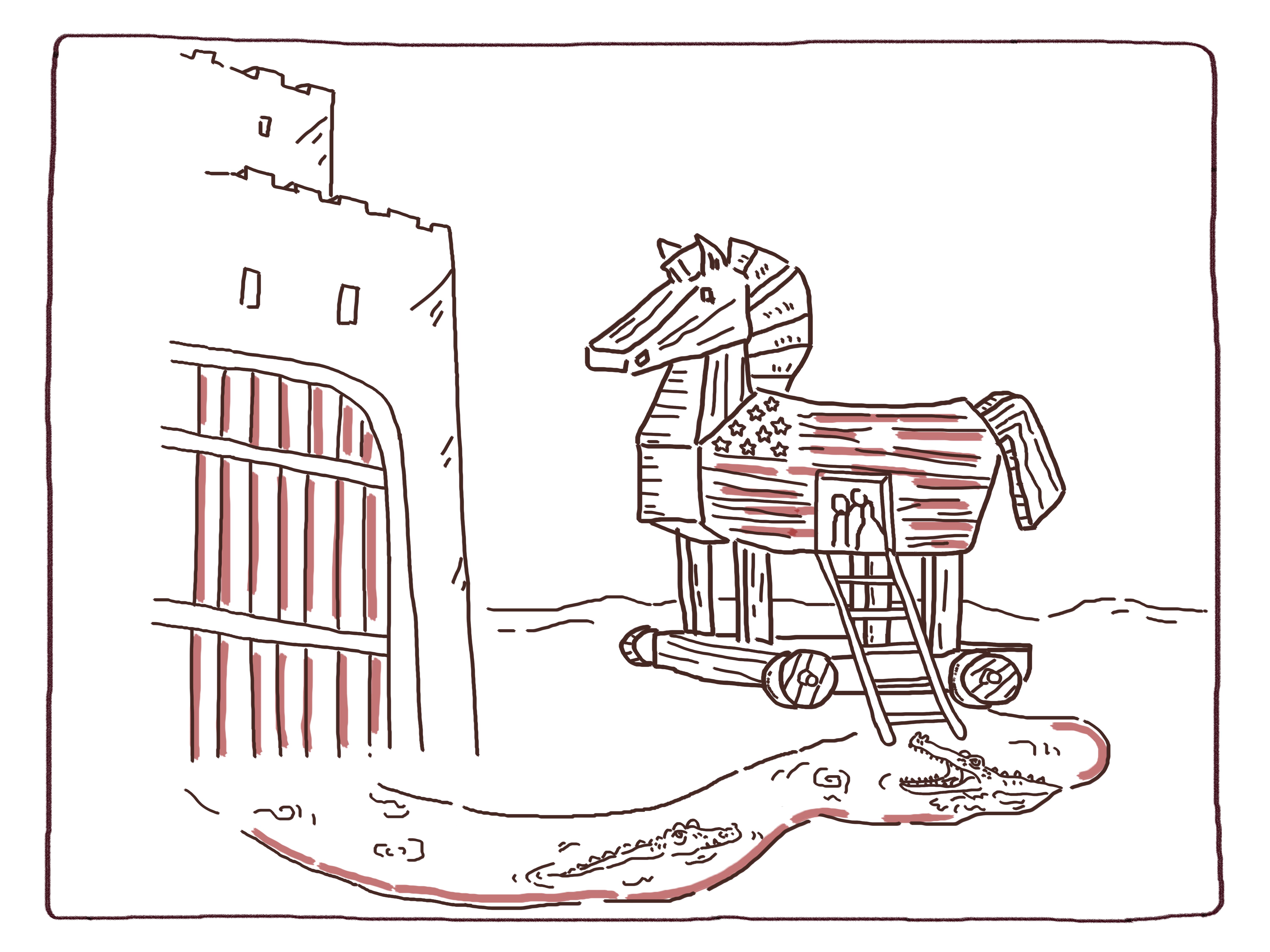
Often my first example of a successful ruse of war is that of the Trojan horse; the Greeks’ sly trick through which they managed to defeat an impregnable Troy which they had besieged (to no avail) for over a decade. This has long held as war lawyers’ ultimate example of brain over brawn, strategy over might, where the use of tricks worked where brute strength failed.
It’s not the only example of course. Deception in battle is as old as warfare itself; the Mongols feigned retreats, the Tudors sent carpenters for ‘work’ into encircled castles to open the gates from within, and, more recently, the Russians paint black and white stripes on their military lorries to confuse Ukrainian drones.
In Christopher Nolan’s version of The Odyssey, however, the director chooses to portray the fall of Troy as an underhanded and dishonorable ploy which defies the will of the gods (Zeus’ law). In the film, a regretful Odysseus looks back at the ruse and doesn’t exalt in it as a heroic act, instead he rues that it has led to an unraveling of the norms of the age in which they live. ‘Our age of bronze is collapsing’, Odysseus says, linking the guilt he feels over the trap with the civilisation’s undoing.
It is difficult not to conclude that Nolan’s retelling of the story is linked to the wars being waged today. Wars where enemies are struck in the midst of negotiations, wars where those in charge of troops say they are not bound by ‘stupid rules of engagement’, declare that this is not a ‘fair fight’, order that there will be ‘no quarter, no mercy’ for our enemies, boast that ‘[w]e are punching them while they’re down, which is exactly how it should be.’ A world lacking the honour which was at the heart of the rules differentiating between trickery and treachery.
After I go through the examples with my students, I show them a headline stating “Trump calls for US to put Chinese flags on fighter jets and ‘bomb the s*** out of Russia”, which quotes the President: ‘And then we say, China did it, we didn’t do it, China did it, and then they start fighting with each other and we sit back and watch’. Treachery, my students decide, before they’ve even finished reading it all.
Nolan’s Odysseus serves as a warning for those who wage wars treacherously, even if he widens his net to include all acts of deception within it. This is a recurring theme in the movie. In a scene where Odysseus fights Penelope’s suitors, Nolan chooses to arm them, in what turns into a fairer fight than the original story. In doing so, he shows contempt for wars fought in a lack of good faith. He seems to say to those who in the middle of war threaten that ‘a whole civilization will die tonight’; the civilization which dies may be your own.
All artwork for the War Law Institute is custom-created by Alisha Yazdani. You can find her on Instagram here.

Ayesha Malik
Ayesha Alam Malik is Director of the War Law Institute, Adjunct Faculty at the Lahore University of Management Sciences, and a contributing op-ed writer for Dawn.

 Maarij Ali Tarar

 N. Waheed

 Camilo Ramírez Gutiérrez

 Zaki Khalid

 Breshna Rani

 Syed Ali Zia Jaffery

 Kamila Khan


 Karina Ochoa Muñoz