
 Zaki Khalid
This piece of the ‘Imagined Futures’ series hypothesises potential future scenarios for Pakistan with significant real-world implications. The primary objective is to subtly discuss inherent vulnerabilities [loopholes] and, secondary, to encourage proactive policymaking. It is a creative exercise designed to generate informed discourse and promote out-of-the-box thinking.
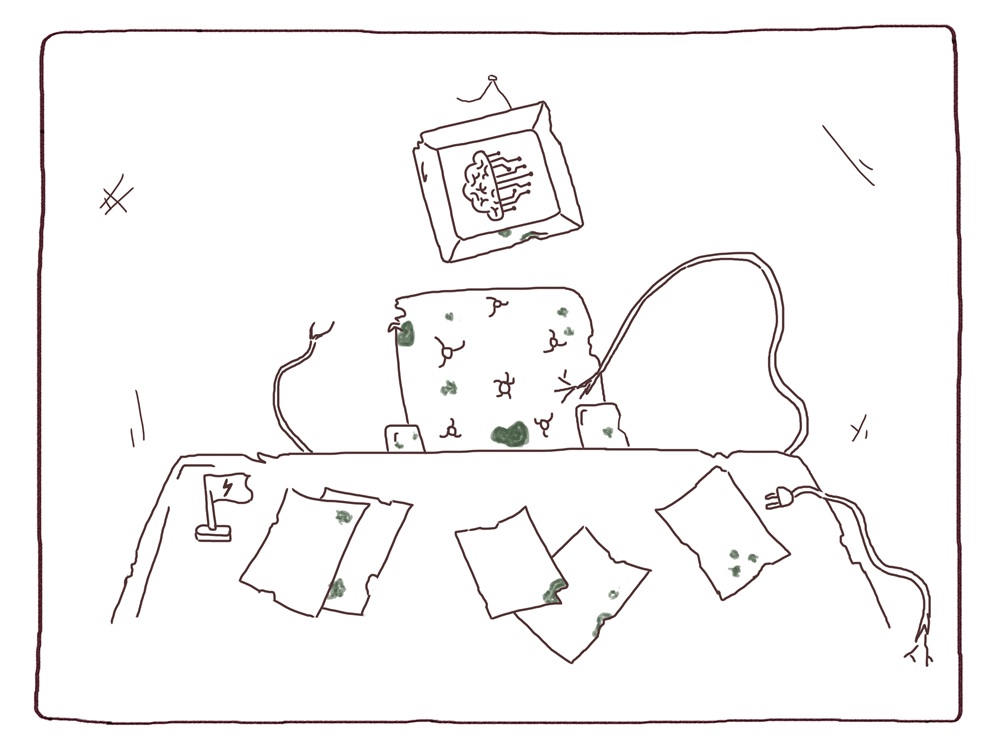
It is 2030 and a federal ministry in Islamabad begins its Monday morning with a familiar workflow broken by an unfamiliar silence. The Large Language Model (LLM) that has served as the base for its analytical and drafting routines for four years has been decommissioned. There has been no cyber attack and no physical strike, only a deprecation notice from a foreign vendor citing ‘organisational restructuring’. Senior analysts, perhaps capable professionals in their early 30s, sit before blank documents unable to find the bridge between what they know and the words that should carry it. Their syntax has left them because years of outsourcing the slow and friction-heavy process of unaided reasoning have produced a generation that can prompt, summarise and approve but cannot compose from scratch.
This is the soft inauguration of what may become the most devastating cognitive shift in Pakistan’s institutional history. We can call it the ‘Calque Class’, borrowing the linguistic term for a loan-translation that wears a native skin while carrying a foreign bone structure. A ‘calque’ is what happens when one language borrows a foreign expression by translating it word for word; the French gratte-ciel [literally “scratch-sky”], is a calque of the English ‘skyscraper’. It looks French but the substance/ essence underneath it is not. The Calque Class are people whose reasoning process has been similarly borrowed, even as their outward fluency in the native idiom conceals this fact. The Calque Class is not made of saboteurs or incompetents; on the contrary, it comprises accomplished professionals who used the best tools available every day for years. The tool’s epistemological grammar [its notion of what counts as a ‘sound argument’, an ‘appropriate risk’ or a ‘balanced framing’] was absorbed alongside its outputs. Four years of daily interaction produced a cohort that thinks fluently in a foreign cognitive idiom while [mistakenly] assuming that the thoughts are entirely its own.
The mechanics of this shift were never sinister. Every LLM reflects the values and assumptions of its training data and the humans who annotated its feedback. Those humans operated within specific institutional, political and cultural contexts. Their frameworks became the model’s implicit grammar, governing not only what the model said but how it structured problems, which considerations it amplified and which it minimised.
In this future, Pakistan finds that its institutional analysis has been slowly but steadily shaped by foreign cognitive infrastructure. The bias is not visible in any single output because it accumulates systemically with time. For instance, a port deal is framed primarily through environmental considerations while security implications are compressed into an appendix, a regulatory proposal softens data sovereignty concerns behind an ‘efficiency’ narrative, a procurement recommendation consistently favours suppliers with particular geopolitical affiliations and so on.
The crisis deepens because Pakistan’s educational pipeline absorbed the same apparatus. Free ‘edtech’ tablets, donor-funded AI tutors and curriculum platforms built on foreign foundational models entered the public and eventually private schooling systems through grants, public-private partnerships and the relentless lobbying of a domestic technology entrepreneur class that profited from being the intermediary. By the late 2020s, an entire cohort of Pakistani students learned to reason inside a foreign model’s grammar. The cognitive raw material for institutional independence was never generated and consequently, the next generation of analysts arrived at their desks already pre-tuned to a borrowed worldview. Recovery, when it becomes necessary, runs into a bootstrapping paradox; the people who would design the cure were educated inside the malaise.
This projected vulnerability, beyond simply intellectual in scope, is externalised cognition that ‘lives’ in buildings. LLMs are basically condensed electricity hosted in concentrated infrastructure with known geo-coordinates and predictable energy demands. Whereas pre-AI institutional cognition was distributed across thousands of human minds in offices and field postings across the country, AI-dependent institutional cognition collapses into a small number of data centre campuses, mostly located outside Pakistan’s sovereign control. To degrade the national analytical apparatus, an adversary need not strike a ministry. A cyber operation against thermal management systems, an export-control bottleneck on specialised chips or simply patience during a prolonged grid failure could achieve the same effect. Pakistan’s unreliable power infrastructure remains its most pressing vulnerability.
The most sophisticated threat, however, is not outright destruction but throttling. A clean shutdown is a legible crisis with a cause and a responsible party; a more insidious capability is ‘managed availability’ or the deliberate and calibrated degradation of model performance during periods of strategic consequence. During trade talks, the model’s economic analysis grows subtly less reliable. During an election cycle, its content moderation tightens around certain forms of domestic political reasoning. During a border dispute, its geographic defaults align quietly with the territorial claims of the country that built it. None of this is verifiable and none can be proven to the standard required by diplomatic protest. The Calque Class, lacking independent analytical capacity, cannot distinguish a degraded tool from its own incompetence.
This dependency was never declared a sovereignty decision because it was procured ministry by ministry as a routine ‘technology upgrade’; perhaps as a licence for ‘marketing efficiency’, as donor-funded ‘edtech’ rollouts in provincial schools or maybe even unaudited integrations across the federal bureaucracy and institutes of higher learning. None of these were debated in parliament as questions of national strategic consequence; where they were debated at all, they were debated as line items in budgets. AI procurement was treated as purely an IT decision whereas it was always a cognitive sovereignty decision.
In this imagined 2030, the country that built the tools also defines what counts as ‘normal performance’, ‘acceptable content’ and ‘updated behaviour’. For Pakistan, the boundary of sovereignty goes beyond physical borders, at the limits of the cognitive infrastructure on which its institutions now run. For the Calque Class itself, the question of which thoughts were ever genuinely its own becomes one which may remain unanswered.
All artwork for the War Law Institute is custom-created by Alisha Yazdani. You can find her on Instagram here.

Zaki Khalid
Zaki Khalid is a private intelligence analyst, trainer and consultant with prior management experience in Pakistan’s national security sector. He has trained/ mentored multiple cohorts of analysts and frequently comments on issues concerning national security, maritime affairs and cyberspace. He can be reached via email: zaki@pantellica.com

 Maarij Ali Tarar
 N. Waheed
 Camilo Ramírez Gutiérrez
 Zaki Khalid
 Breshna Rani
 Syed Ali Zia Jaffery
 Ayesha Malik
 Kamila Khan
