
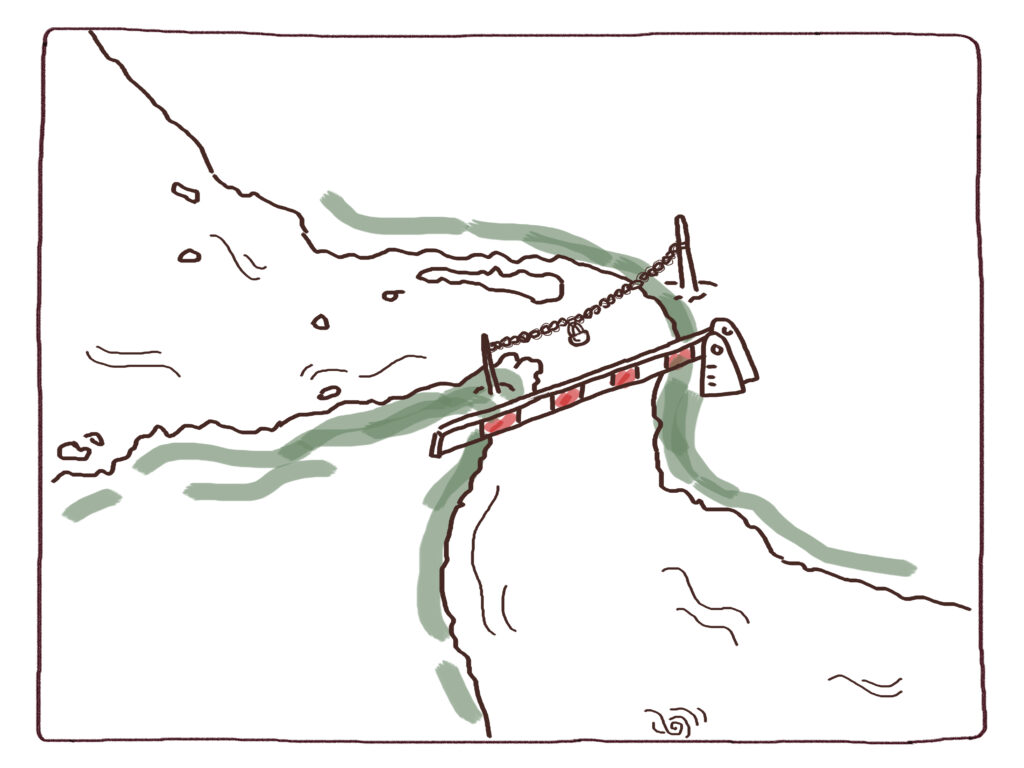
In April, I argued that the American attempt to choke Iran through the Strait of Hormuz would bite in the short term but was unlikely to be decisive on its own. Six months later, the experiment is no longer hypothetical, and it has been harsher than I expected. It has also raised a question I largely set aside: not whether the blockade works, but whether the law allows it and whether anyone in this war is willing to be bound by it.
What the squeeze has done
The timeline matters. The war began on 28 February. Iran declared the Strait closed to “unfriendly” shipping within days. The United States blockaded Iranian ports from mid-April to the end of May, an interim truce collapsed on 8 July, and the blockade was reinstated on 14 July. This week, US Central Command marked a hundred days of the reinstated blockade.
My April argument leaned on a cushion: well over a hundred million barrels of Iranian crude afloat on tankers, and a grey fleet capable of leaking cargoes past enforcement. That cushion has been spent. Kpler estimates that Iran now holds perhaps ten million barrels outside the blockade line, down from more than 120 million before the war. Shipping intelligence firms report that crude exports through Hormuz, above two million barrels a day before the war, have been at zero since September, and Vortexa recorded seaborne exports falling to zero in the second week of that month. CENTCOM claims the blockade has denied Iran $25 billion in oil income, a figure that is Washington’s own and should be read as such.
The domestic damage is visible. The IMF’s October 2026 World Economic Outlook projects a 7.6 percent contraction in Iran’s real GDP this year. Official inflation reached 73.6 percent in September, while the IMF projects annual-average inflation of 78.6 percent for 2026. The rial has repeatedly set record lows. The rial has repeatedly set record lows. Even so, Iran’s central bank governor dismisses talk of collapse, and Tehran continues to strike shipping in and around the Strait, with dozens of vessels attacked in October alone.
So I will revise my thesis rather than defend it. The blockade has inflicted greater economic damage than I anticipated. But economic exhaustion and political capitulation are not the same thing. Endurance remains Tehran’s strategy, and the question is whether a contracting economy will eventually force the state to yield. The blockade cannot answer that question by itself.
A blockade is an act of war, not a sanction
This is where the law enters. A naval blockade is a belligerent act. The law of naval warfare, reflected in the 1909 London Declaration and the 1994 San Remo Manual, permits it only if it is declared, effective, impartially applied, and does not cut neutral states off from their own ports or aim to starve a civilian population. Some legal commentators argue that the US Navy has largely met these procedural requirements.
But procedure is the easier half. The harder half is the UN Charter. A military blockade is a use of force for Article 2(4), and the US administration has itself acknowledged as much. If the war it serves was launched without Security Council authorization and without a valid basis in self-defence, as many international lawyers contend, the blockade cannot acquire a lawful foundation simply by being properly executed. Its compliance with the rules of naval warfare does not cure an unlawful resort to force.
The situation is also awkwardly inconsistent: Washington has at times described hostilities as paused while continuing an act that, in law, is itself hostile.
None of this absolves Tehran. Transit passage through international straits is a right of all shipping under the law of the sea, and it is widely regarded as customary law binding even states that, like Iran, signed UNCLOS but never ratified it. Closing the Strait to “unfriendly” vessels, mining its approaches, attacking neutral merchant ships, and creating a Persian Gulf Strait Authority to levy tolls cannot be squared with that right. The head of the International Maritime Organization has said plainly that tolls are contrary to international law. Twenty-four seafarers have died in the crisis.
The honest conclusion is uncomfortable for partisans on both sides: Iran’s closure is unlawful, America’s blockade is, on the better view, unlawful in its Charter foundations, and each party cites the other’s violation as its own license. That is not a legal argument. It is the logic of a feud.
Minab
The same question arises in a different form on land. The rules governing a naval blockade concern how a state may exert economic pressure on an adversary. The law governing attacks concerns how it may use lethal force. Both impose limits that military necessity cannot simply erase.
The war’s first day produced one of the starkest tests of those limits.
On 28 February, while classes were in session, a missile struck the Shajareh Tayyebeh girls’ primary school in Minab, in Hormozgan province, overlooking the Strait. More than 150 people were killed, most of them girls aged between seven and twelve. The UN’s fact-finding mission reported 157 people killed, including 123 children. Iranian officials and UNICEF have cited higher figures for girls alone. Whatever the precise number, a classroom full of children was destroyed.
The evidence has pointed steadily toward the United States. Preliminary Pentagon findings reported by NBC and NPR concluded that a US Tomahawk was likely responsible and that outdated intelligence was the probable cause; the school had been separated from an adjacent Revolutionary Guard compound years earlier and was clearly marked as a school. In September, the UN’s Independent International Fact-Finding Mission on Iran found reasonable grounds to believe the United States committed the war crime of launching an indiscriminate attack, that the school was clearly identifiable with no evidence of military use, and that the failure to update targeting data went beyond mere negligence. The State Department has dismissed the report as not credible. Bloomberg reports that the Pentagon’s own completed investigation will not be released before the 3 November midterm elections.
Precision matters here, and it serves the victims better than adjectives do. The UN mission’s finding is of an indiscriminate attack, a violation of the duty to distinguish between civilians and military objectives and to take precautions in attack. That duty is customary and binds the United States whether or not it has ratified Additional Protocol I. It is a finding of reasonable grounds, not a conviction, and it is exactly the kind of finding that an independent investigation, published and acted upon, is supposed to test. The refusal to publish is not neutral. It converts a tragedy into an accountability gap.
One story, not two
It is tempting to treat Hormuz as an economics story and Minab as a human-rights story. They are the same story. Both ask whether coercion, whether by starvation of revenue or by missile, is subject to a ceiling that the coercer did not set for itself. The rules on blockade, on transit passage, and on the protection of schools were all written because states, at moments of confidence, concluded that unconstrained force would eventually be turned on them.
For the Global South, this is not abstract. The costs of a war fought on the Gulf’s shores are borne far beyond it: in crude trading above $100 a barrel, in insurance and freight premiums, in stranded seafarers, in the import bills of states that never chose a side. Pakistan has a particular stake. As a principal mediator behind the Islamabad memorandum, it has watched a negotiated reopening come close and slip away. States in this position have a direct interest in the consistent application of international law. They lack the power to enforce their preferences through force, and depend more than great powers do on rules that constrain it.
The Strait, in other words, is not a switch that can be flipped to produce a clean outcome. Neither is the law. In Robert Bolt’s A Man for All Seasons, Thomas More’s son-in-law, Roper, declares that he would cut down every law in England to catch the Devil. More asks him where he would stand when the Devil turned on him, and the laws were all laid flat. The question has outlived its century. A state that clears the legal forest to reach its enemy finds, sooner than it expects, that the clearing exposes it too, and every neutral state behind it.
International law does not switch off when deterrence becomes inconvenient, nor does it apply only to adversaries. The test in the months ahead is whether the same standard is applied to Iran’s tolls, America’s blockade and the destruction of a classroom in Minab. If it is not, we should stop calling the result order.
Sources:
- My earlier Substack piece https://creativelydestruct.substack.com/p/the-strait-is-not-a-switch?utm_source=share&utm_medium=android&r=3pwkhp
- Iran oil exports and revenue outlook: agbi.com, “Iran oil exports through Hormuz dry up under US blockade,” 20 Oct 2026 https://www.agbi.com/oil-and-gas/2026/10/iran-oil-exports-through-hormuz-dry-up-under-us-blockade/
- Strait control claims, ship attacks, CENTCOM $25bn claim: https://www.aljazeera.com/news/2026/10/17/us-and-iran-both-claim-control-of-strait-of-hormuz-amid-attacks-on-vessels
- 100 days of reinstated blockade: https://cbsnews.com/live-updates/iran-war-trump-us-ceasefire-talks-ongoing
- Timeline: https://en.wikipedia.org/wiki/2026_Strait_of_Hormuz_crisis
- Storage (Kpler, ~10m vs >120m barrels), inflation, rial: https://www.derstandard.at/story/3000000342314/americas-blockade-is-breaking-irans-economy-but-not-yet-its-regime
- IMF projection of contraction https://www.imf.org/en/publications/weo/issues/2026/10/13/world-economic-outlook-october-2026?utm_source=chatgpt.com ; Official inflation 73.6% (Sept), IMF Inflation estimate https://www.imf.org/external/datamapper/PCPIPCH@WEO/AFG/ARM/TKM/TUR/PAK/IRN/IRQ Vortexa export data: bdnews24.com/world/z83t47szk8 (Reuters) https://bdnews24.com/world/z83t47szk8
- Blockade law and the Charter: https://www.justsecurity.org/142005/blockade-article-2-un-charter/ ; https://www.justsecurity.org/153505/iran-conditions-hormuz-international-law/
- Transit passage and tolls: Reuters explainer (al-monitor.com, 16 Apr 2026) https://www.al-monitor.com/originals/2026/04/explainer-can-iran-legally-impose-tolls-strait-hormuz ; IMO Secretary-General interview, https://www.aljazeera.com/news/2026/4/12/iran-must-not-be-allowed-charge-tolls-in-strait-of-hormuz-un-watchdog-says
- Minab: https://www.unicef.org/press-releases/brutality-war-measured-childrens-lives-hostilities-escalate-iran ; https://www.npr.org/transcripts/nx-s1-5744981 (UN fact-finding report) https://www.iranrights.org/library/document/5359?utm_source=chatgpt.com ; https://www.nbcnews.com/politics/national-security/pentagon-investigation-iran-school-strike-finalized-rcna350170 ; Bloomberg via https://www.commondreams.org/news/pentagon-minab-strike-investigation (report withheld until after midterms)
- https://www.cnn.com/2026/10/17/economy/us-iran-war-shipping-trade-hormuz-bab-el-mandab-strait-intl-vis
All artwork for the War Law Institute is custom-created by Alisha Yazdani. You can find her on Instagram here.