
 Zaki Khalid
This inaugural piece of the ‘Imagined Futures’ series hypothesises potential future scenarios for Pakistan with significant real-world implications. The goal is two-fold: to subtly discuss inherent vulnerabilities [loopholes] and encourage both proactive policymaking and contingency planning. Ultimately, it is a creative exercise designed to generate informed discourse and promote out-of-the-box thinking.
In the not-too-distant future, the remnants of globalisation continue to dissipate. Countries, shedding the inter-connectedness of a previous era, drift toward an assertive authoritarianism where each is backed by a rigid interpretation of classic ‘sovereignty’. In this new world order, more and more countries have decided to silo their national cyberspace, transforming it into a self-regulated medium that is no longer dependent on the whims of foreign governments or corporations.
The conceived idea is to minutely inspect the flow of information crossing borders. But this is not the North Korean model of a hermetically-sealed intranet. Economic necessities, diplomatic engagements and requirements pertaining to national security ensure that countries remain globally connected. The physical mechanisms of connection i.e. the vast networks of submarine fibre optic cables that form the true backbone of the Internet, remain largely unchanged as a shared vulnerability lying in the silent depths.
Imagine a Pakistan that has [against the odds] navigated a treacherous security dilemma. It has managed to somehow stabilise its crippled economy after settling border disputes in the contentious western theatre. Despite this, a persistent existential threat continues to loom from its eastern adversary. India, quantitatively superior in military terms, has ascended to become one of the top three global economies powered by a youthful population and a government that has asserted itself through sweeping internal structural reforms. Despite lingering socio-cultural fissures, its economic prestige allows it to sail through controversies that might have previously hampered its progress. In short, it has potently become a force to be reckoned with throughout the Global South.
In this charged environment, Pakistan is once again labelled ‘non-cooperative’, or a ‘nuisance to regional harmony’ based on Indian allegations of cross-border terrorism or other deflective rhetoric designed to divert attention from the latter’s unresolved internal fissures. This is not a new tactic but it is now solidified over the decades by a right-wing regime in New Delhi singularly focused on the ideological supremacy of a revived Hindutva. With the economic and demographic weight of nearly a billion people of Hindu origin, including powerful diasporas, the government possesses the leverage to proclaim a status eerily similar to that which Israel claims in defending itself against proven charges of systemic aggression. Standing on strong economic foundations while reaping the benefits of global trade, this new India is simultaneously ultra-vigilant when it comes to managing its hard-gained prestige. It knows from past experience that Pakistan has, on multiple occasions, skillfully exploited the information space to its advantage through cyber and electronic means.
To neutralise this perceived threat, therefore, the Government of India activates a contingency plan for a pre-emptive chokehold on Pakistan’s information paradigm. The mission rests on two prongs operating in tandem. The first involves the remote activation of dormant malware which was secretly installed years prior within the industrial control systems of submarine cable landing stations in Karachi and along new sites in Gwadar and Ormara. The malware is designed to have direct physical effects through targeting of each station’s power feed equipment and network controls. Leveraging poor infrastructure planning and resource constraints that led to these critical systems being grouped together, the malicious code retards and eventually shuts down the equipment that supplies power to undersea repeaters which are essential for amplifying the optical signals along the cables stretching from Pakistan’s coastline to the branching points of the main international lines.
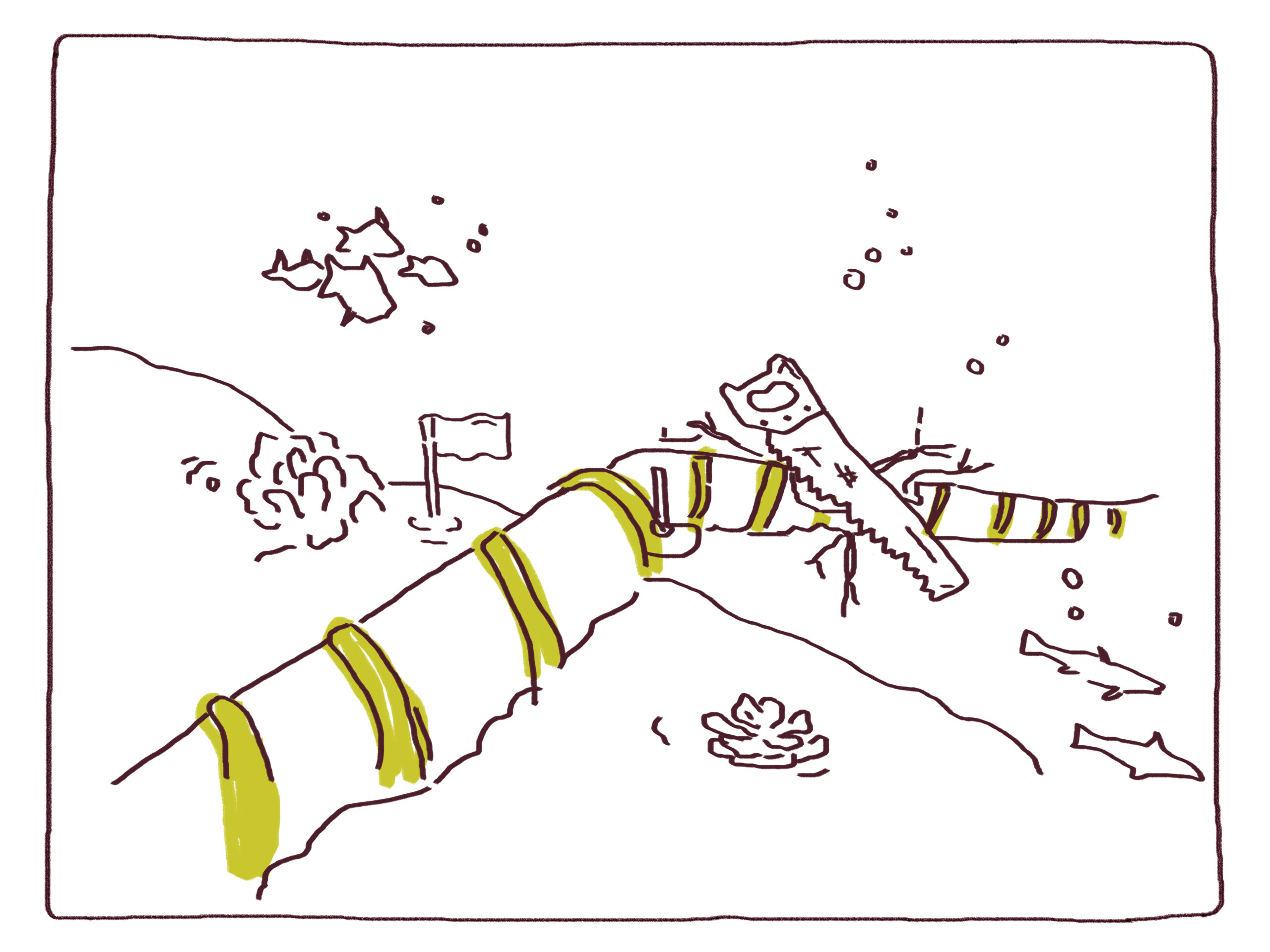
Simultaneously, the second prong of the attack unfolds in the deep. To counter any of Pakistan’s risk calculations and ensure a delayed response, the Indian government tasks its marine commandos with employing autonomous Unmanned Underwater Vehicles. These submersibles patrol the depths of the Arabian Sea near the crucial branching points hundreds of kilometres from Pakistan’s coast. Their mission is to physically damage the cables. This entire operation is carefully designed to take place outside Pakistan’s extended economic zone, reducing the legal implications for India while giving it ample room to manoeuvre and deny involvement. This ensures that even if Pakistan miraculously manages to restore power to said landing stations, the country will remain disconnected since the main undersea lines to the global Internet will have all been severed. The diversification of landing stations away from just Karachi proves to be a moot point because proscribed separatist organisations, supported by Indian intelligence agencies, could be used as proxies to inflict physical damage on terrestrial infrastructure along Balochistan’s vast coastline.
The result is a digital blackout. Pakistan would still have access to industrial-era forms of mass communication [radio, perhaps] but its connection to the global conversation is severed. We imagine a situation where, due to stringent and perhaps short-sighted regulatory policies, Pakistan’s relationship with Big Tech corporations, including those providing satellite-based Internet services, is hollow. Any limited satellite connectivity would remain subject to the whims of a megalomaniac foreign oligarch controlling the medium; going beyond, any backup terrestrial node coming from its northern neighbour would be unable to handle the national load. The federal government may be able to disseminate some information electronically to its people but its overall ability to reach the domestic populace, build a narrative on the global stage and lay bare India’s sabotage is completely nullified. The ordinary citizens and influential opinion makers do not have the means to make sense of the issue then discuss how to deal with it. Only a handful of individuals in specific institutions might have access to a satellite link but their efforts would be futile against the coming storm of disinformation.
This crisis is compounded by the geopolitical architecture of the future. By now, states have acknowledged that submarine cables are a shared global commons, much like outer space. To that end, multilateral forums in specific regions have been mandated with the responsibility of guiding the overall functioning of international cable consortiums. For the Western Indian Ocean, that body is the Indian Ocean Rim Association (IORA). The idea is to have member states pool resources, subsidise repairs and upgrades and distribute stakes and responsibilities thus preventing any single country from dominating the critical infrastructure. Herein lies Pakistan’s fatal weakness. Even in this future, Pakistan remains the only major littoral country in the Indian Ocean Region excluded from IORA. Since the late 1990s, India has consistently vetoed Pakistan’s request for membership and the charter dictates that a single veto is sufficient to block an application. While extra-regional powers like the US, Russia, France and China are old members; even Israel has been recently inducted on account of its port of Eilat on the Red Sea. Pakistan is left outside, voiceless.
When the sabotage happens, Pakistan has nowhere to turn. As it rushes to restore power and remove hostile intrusions from its terrestrial infrastructure, it needs the active support of the international community to investigate the destruction that occurred far outside its territorial waters. But its appeal to IORA falls on deaf ears. Without diplomatic representation or stake in the forum, Pakistan cannot even force the issue onto the agenda. The matter is left entirely to the IORA Secretariat’s discretion which, under heavy Indian influence, decides the issue does not merit attention. Pakistan is left with the option of highlighting the issue in less influential forums or before the United Nations which would very likely prove an exercise in futility.
The immediate impact within Pakistan is catastrophic. The country is plunged into a state of digital blindness. Military and civilian formations dotted across the country, from the shores of Sindh and Balochistan to the frontiers of Azad Jammu & Kashmir and former Tribal Areas are hampered by a lack of communication and coordination. When official circles themselves lack information, the situation for media, civil society and ordinary people is one of escalating chaos and rampant speculation. Has another conflict been triggered? By whom? Internal distrust between the federal government and a populace already tired of elite capture and privilege is severely amplified. Pakistan’s military response options and more importantly, its ability to shape the battlefield before engaging, are significantly reduced.
Compounding this digital blindness is a pre-existing political schism that the crisis rips wide open. The fractious working relationship between the federal government and the provincial governments, particularly Sindh and Balochistan [where the targeted infrastructure is located], cripples any coherent national response. Directives from Islamabad are met with deep-seated suspicion in Karachi and Quetta. Provincial leadership, long wary of federal overreach, views the crisis not as a moment for national unity but through the lens of regional autonomy and historical grievances. Instead of promoting rigorous cooperation, the response is subjected to bureaucratic paralysis and political finger-pointing. Information is hoarded, parallel and uncoordinated investigations are launched and a lot of precious time is lost to jurisdictional squabbles. This internal division [a historical political fault line] is precisely the vulnerability which the attack was designed to exploit. All this turned a national security crisis into a cascading failure of governance.
This is not a quiet darkness but a loud and terrifying one. The digital void is filled by fear. Word-of-mouth becomes the primary information network, replacing WhatsApp for “Rumour Intelligence” (RUMINT) that spreads faster than any virus; stories of routine national air patrols mistaken for adversarial combat sorties, of hearsay-based border skirmishes in the east and sabotage at critical energy infrastructure of strategic nature; perhaps even that the façade of ‘democracy’ has once again been rendered obsolete to reveal open secrets. ATMs go dark, freezing commerce and sparking panic among the civilian populace as well as the timid IT sector tethered deeply to offshore companies. The fragile trust that underpins society begins to fray. Every delayed response from the government is interpreted as a sign of collapse. This sense of being trapped and blinded while an unseen enemy purportedly manoeuvres beyond the horizon paralyses the country. The prevailing uncertainty is already ripe for an internal implosion long before any conventional strikes are made [if at all].
By the time Pakistan’s compartmentalised institutions can piece together what has happened, India has already seized the narrative. Through its ever-aggressive mainstream media and an unimpeded global cyber presence, it frames the story. Any information that subsequently emerges from Pakistan is labelled an afterthought or a wild conspiracy theory with no standing. The legal complexity of investigating sabotage on international consortium property in international waters, especially without the endorsement of the relevant regional bloc, makes it almost impossible for Pakistan to hold the perpetrator to account.
The entire fiasco begs the question of whether Pakistan was ever truly cyber-sovereign in the first place.
All artwork for the War Law Institute is custom-created by Alisha Yazdani. You can find her on Instagram here.

Zaki Khalid
Zaki Khalid is a private intelligence analyst, trainer and consultant with prior management experience in Pakistan’s national security sector. He has trained/ mentored multiple cohorts of analysts and frequently comments on issues concerning national security, maritime affairs and cyberspace. He can be reached via email: zaki@pantellica.com

 Maarij Ali Tarar
 N. Waheed
 Camilo Ramírez Gutiérrez
 Syed Ali Zia Jaffery
 Breshna Rani
 Alex Lawson
 Ayesha Malik

