

 Anoshay Fazal
A Converging Rights-Based Approach To Climate, Displacement And Conflict: The Duty to Co-operate and the potential to leverage Collective Action in South Asia
‘[…]in the context of climate change, States have a customary obligation to co-operate […] Such a duty of co-operation is founded on the recognition of the interdependence of States and the ensuing need for solidarity among peoples.’
ICJ Advisory Opinion on the Obligations of States in respect of Climate Change (para. 364)
‘Cooperation is our only viable solution to this global climate crisis.’
The Nexus between Climate Change, Displacement and Conflict
In a landmark move, the ICJ in its Advisory Opinion on the Obligations of States in respect of Climate Change affirms the duty for States to co-operate to tackle the serious challenges posed by climate change and notably, reaffirms the principle of non-refoulement and complimentary protection owed to those displaced due to climate change. This signifies a convergence towards a customary, rights-based approach to displacement and protection in a changing climate.
The nexus between climate change, displacement and conflict is a complex one, due to the nuanced, sometimes slow-onset and reciprocal nature of these issues, but it is certain that they are parallel and concerning realities, for the future. There are currently over 80 million individuals internally displaced within their own borders, with climate change being a significant driver of this displacement. Climate change is a dual ended sword vis-à-vis migration, in that it induces displacement (internal and cross-border), and adversely impacts existing forcibly displaced populations, living in precarious conditions. Moreover, rising geopolitical tensions and resulting armed conflict are severely compounding the natural environment and displacement, with the effects of global military emissions surpassing some of the largest emitter States. It is, therefore, alarming to witness the diminishing focus on climate change, as opposed to an expansion in defence spending in US and EU policy, the securitisation of borders, and the fact that armed conflict has not been directly addressed at COP29 or COP30. Hence it would be unreasonable to take conflict, climate change and displacement as isolated concerns.
Climate Security in South Asia
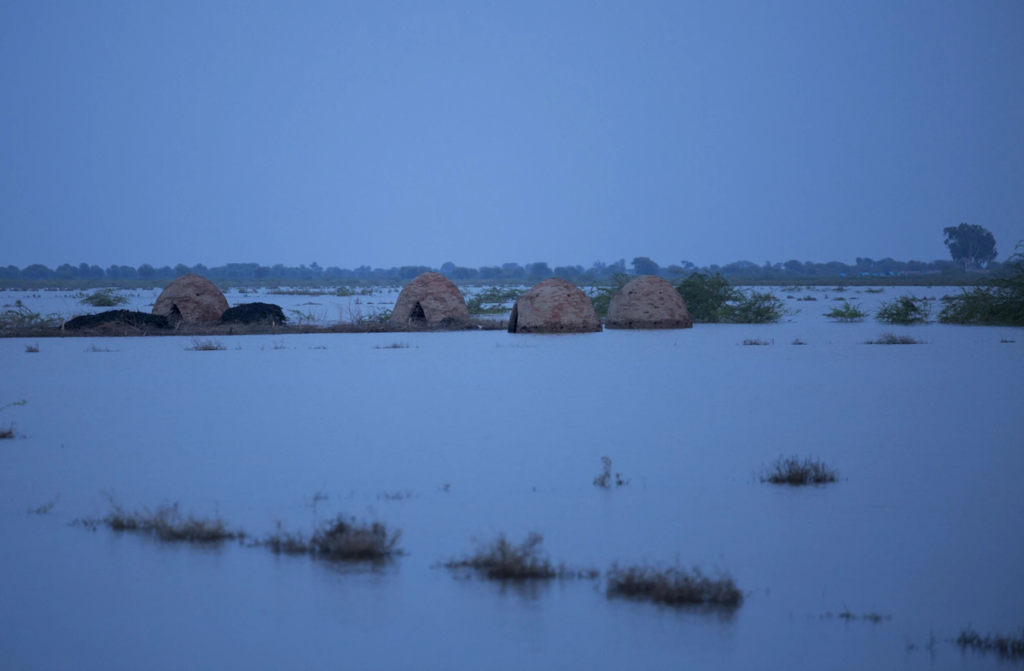
Similar tendencies towards an increase in militarisation and securitisation are also unfolding in Asia. In May 2025, the suspension of the Indus Water Treaty between India and Pakistan, was part of the reason the two countries became embroiled in a short but quickly escalating war. Relatedly, ‘national security’ has increasingly become the determining factor in the treatment of Afghan refugees in Pakistan. The recent escalation in tensions between Pakistan and Afghanistan triggered the closure of all refugee camps in Khyber Pakhtunkhwa. The porous nature of the international border between Pakistan and Afghanistan makes it extremely difficult to prevent cross-border migration and if these underlying causes are not addressed, pose a serious risk for future conflict. These geopolitical ramifications illustrate the nexus between climate, displacement and conflict for South Asia. A recent report on climate migration in the region predicts displacement of ‘over 800 million people by 2050, further straining the region’s economies’. The 2025 monsoon spell has left the country reeling, with 1,037 lives lost and an estimated PKR 822 billion in economic losses. In Afghanistan, nearly 9 million people were impacted by climate change over the last year. It is thus cognisant to foresee that climate change will be the primary driver for forced migration across South Asia. Consequently, the weaponisation of resources and collapse of climate diplomacy will be catastrophic for the region, likely leading to an increase in conflict between and within ethnically fragmented societies and stained economies.
A number of South Asian countries have not ratified the 1951 Refugee Convention, and regrettably the convention definition currently does not extend to ‘climate refugees’. Similarly, while the UNFCCC and the Paris Agreement recognise a link between climate change and mobility through its Task Force on Displacement, established under the Warsaw International Mechanism for Loss and Damage, the mechanism is effectively weak as it cannot impose binding obligations on parties. This weak effectivity issue also arises for the Global Compact for Safe, Orderly and Regular Migration (GCM).
Climate Change and Refugee Rights in Pakistan
Prominently, while Pakistan is not a party to the Refugee Convention, the judiciary in Rahil Azizi v. The State PLD 2024 Islamabad 231 has advanced a customary international law interpretation to the principle of non-refoulement under Article 3 of the CAT, to which Pakistan is signatory. Pakistan is thus bound by this customary international law obligation – an obligation that will be owed to refugees in the future and is now being constructed by international and regional courts as an obligation owed to those displaced due to climate change.
Moreover, the Constitution of Pakistan also extends a number of guarantees to all ‘persons’ and not just citizens, including the right to life which has been interpreted widely by the courts, notably in the Shehla Zia v. WAPDA case (PLD 1994 SC 693), where the Supreme Court of Pakistan interpreted Article 9 as covering the right to environment. This must now be read in conjunction with the 26th Amendment to the Constitution of Pakistan which inserts article 9A: ‘Every person shall be entitled to a clean, healthy and sustainable environment’. As a party to the UNFCCC, the Kyoto Protocol and the Paris Agreement, Pakistan is also bound by international commitments arising under these instruments. Reflexively, perhaps, Pakistan promulgated its Climate Change Act in 2017, establishing the Pakistan Climate Change Authority, which is to work under the Pakistan Climate Change Council. While the Act directs the authority to establish mechanisms for the implementation of policies at the federal and provincial levels to adapt policies to mitigate the impacts of climate change, it lacks operative enforcement mechanisms and does not stipulate penalties for those found in breach of the law. In addition, it does not consider climate-induced displacement. In October 2024, the Climate Refugees Rights and Protection Bill 2024 was tabled in Parliament. The Bill (if passed) would mark the first instance of a country providing a legally binding definition of ‘climate refugees’. However, the definition is restrictive and unclear, while it recognises climate refugees as a distinct category, it limits this understanding to persons forcibly displaced within Pakistan (Art. 2(d)). Overall, there exists a substantial foundational framework, which if amended and implemented appropriately, can be utilised to address the issues to climate change, displacement in averting domestic conflict.
The Right to a Clean and Healthy Environment: A Standalone Right
‘Taken together, the statements, treaty participation, national constitutional and legislative provisions, judicial reasoning and official submissions form a beyond doubt converging and convincing body of evidence. They firmly confirm that a substantial number of States, across all regions and legal traditions, engage in the recognition and implementation of the right to a clean, healthy and sustainable environment not as a mere matter of policy discretion or discretional political preference, but out of a sense of legal duty. This belief demonstrates that the practice previously identified is accompanied by the requisite opinio juris. Consequently, both conditions for the existence of a customary norm are fulfilled’.
SEPARATE OPINION OF JUDGE AURESCU – ICJ Advisory Opinion (p.17)
Notably, in international fora we can observe a convergence towards a rights-based approach to the right to a healthy environment as inextricably linked to the accessibility of fundamental rights and thereby extending obligations for States toward those displaced due to climate change. Citing the Teitiota decision, the International Court of Justice’s Advisory Opinion (AO) on the ‘Obligation of States in Respect to Climate Change’ states:
‘In the view of the Court, States have obligations under the principle of non-refoulement where there are substantial grounds for believing that there is a real risk of irreparable harm to the right to life in breach of Article 6 of the ICCPR if individuals are returned to their country of origin)’ (para 378).
By recognising ‘substantial grounds’, the court clarifies prior confusion vis-à-vis ‘imminence’ of harm, as Michelle Foster and Jane McAdam suggest ‘that the appropriate frame of analysis is one of foreseeability of harm—not imminence’ (p. 982) for the invocation of international protection, the foreseeability of climate-induced displacement is now evident. It is also worthwhile highlighting that climate-change and statelessness are increasingly being recognised as a fast emerging issue, (see Global Action Plan to End Statelessness 2.0 and Public Consultation on Nationality and Statelessness in the Context of Climate Change).
Correspondingly, on September 30 2025 the UN Committee on Economic, Social and Cultural Rights issued General Comment No. 27, affirming that a clean, sustainable and healthy environment is a necessary prerequisite for the enjoyment of economic, social and cultural rights. GC 27 also refers to the ICJ-AO, in addition to the Inter-American Court of Human Rights’ Advisory Opinion on the obligations of States in responding to the climate emergency, OC-32/25 2025 (OC-32/25), and the ITLOS Advisory Opinion on climate change and international law. This strong engagement by international and regional judicial bodies on the right to a clean environment and displacement substantiates an emerging rights-based customary international law approach to these issues.
While the ICJ’s Advisory Opinion falls short on clearly delineating to whom these obligations are owed, this is remedied through the OC-32/25 which provides a cohesive ‘differentiated and human-centred approach’. The OC-32/25 recognises that ‘the impacts of climate change can also affect populations already in situations of forced displacement, exacerbating the risks they face and driving additional displacement, as well as prolonged and continuous displacement’ (para. 419). Accordingly, the OC-32/25 offers a comprehensive framework of obligations for States, including the obligation to protect sources of livelihood, food security and housing, institutionalise regulatory and budgetary measures and calls on local, national and regional stakeholders to co-operate to implement these measures (paras. 422-434).
Consequently, if South Asian nations are committed to addressing these pressing challenges, the evolving international legal environment provides a significant platform for establishing binding obligations and equitable solutions (para. 365, ICJ AO).

Recommendations for Pakistan:
At the national level, Pakistan should sign and ratify the Convention and Protocol Relating to the Status of Refugees, the two Statelessness Conventions and implement a domestic framework that covers the diverse categories of forced migrants (including refugees, asylum-seekers, stateless persons, economic migrants and the internally displaced). Secondly, the State must enhance institutional autonomy for the effective realisation of the Constitutional guarantee offered under Articles 9 and 9A. Thirdly, the State must amend the Climate Change Act to stipulate binding obligations towards individuals displaced by climate-change. In addition, a revised refugee and asylum policy should include ‘the establishment of appropriate migration categories such as humanitarian visas, temporary stay permits, and/or protection under refugee status or other similar status, which can provide them with protection against refoulement’ (para.433, OC 32/25) (see also the Nansen Initiative).The envisioned legal status must also provide access to the right to work in the formal sector, housing, access to public healthcare and education in line with Pakistan’s international human rights obligations.
Recommendations for the region:
At the regional level the SAARC could be leveraged as a mechanism for coordination with neighbouring countries with the pivotal aim to prevent and address conflict. Firstly, South Asian nations must develop combined mitigation strategies, focused on regional disaster preparedness, clean energy and water security and resource management. Secondly, Pakistan and Afghanistan must develop strong mechanisms to manage cross-border migration and neutralise challenges to national security. Thirdly, Pakistan, India and Afghanistan must integrate climate challenges and the relational proximity to conflict within their military strategies, capacity-building and budgets. Fourthly, they must foster efforts to facilitate research, scientific advances and technological exchange. Lastly, a regional cooperation apparatus must be supplemented with a strong judicial enforcement mechanism akin to other regional frameworks for dispute-settlement and for the protection and promotion of human rights, under a legally binding regional treaty. Additionally, a cooperative strategy holds the dual promise of reduced border tensions and enhanced economic and political stability. Enhanced cooperation will allow for increased trade and efficient resource management in the region. Moreover, the duty to co-operate also arises under the Paris Agreement and advances the protection and advancement of the right to an environment that is inextricably linked to Sustainable Development Goals (UNSDGs) in countries most impacted by climate-change and significantly can serve as a platform for leverage diplomatic cohesion and credibility at global forums for climate funding.
Recommendations for the Global South:
In response to developments within international and regional legal fora, this is a decisive moment for the Global South to leverage collective action to seek redress and climate funding from the international community to address these challenges (see Belém Declaration on Global Green Industrialization). The “Missing in (Climate) Action? Displaced Communities and the Search for Durable Solutions: Bangladesh as a loss and damage case study” advocacy report highlights key positive interventions by CSOs, enabling access to more durable solutions for those protractedly displaced in Bangladesh. Crucially, considering the ICJ-AO, it calls for the expansion of the legal concepts of duty-bearers to include polluting nations, towards more equitable solutions in the context of ‘Loss and Damage’. The ICJ makes it clear ‘that wealthy countries have a legally binding duty to support mitigation, adaptation and loss and damage efforts across the developing world.’ This is also an important opportunity to lobby for a legally binding treaty and an additional protocol under the Refugee Convention of 1951 that provides legal protection for persons displaced across borders due to climate-change and emphasise responsibility sharing for the same, stressing the ‘important aspect of causality and international responsibility that must be considered when referring to climate change displaced persons.’ Moreover, the first global treaty on the Protection of Persons in the Event of Disasters is on the horizon for 2027, it is imperative that countries most vulnerable to climate change ‘ensure that displacement, evacuation and planned relocations are reflected in its provisions and, crucially, that commitments to international cooperation are backed by the financial resources necessary to make them real.’
Without robust international cooperation, legally enforceable obligations and equitable, well-financed collective action aimed at addressing climate change and displacement, the pursuit of regional and global peace and security will remain an unattainable ideal.
The author would like to thank Ayesha A. Malik, Professor Valsamis Mitsilegas and Jaydon Souter for reviewing earlier draft(s) of this piece and special thanks to Saiyna Bashir for generously providing the photographs featured in this piece.
All artwork for the War Law Institute is custom-created by Alisha Yazdani. You can find her on Instagram here.

Anoshay Fazal
Anoshay Fazal is a Doctoral Candidate, and Graduate Teaching Fellow at the School of Law and Social Justice, University of Liverpool. She specialises in refugee law, forced migration, and human rights, with nearly a decade of experience across academic, policy, and capacity-building roles. Her work sits at the intersection of law, forced migration and displacement, human rights and social justice, with a strong commitment to evidence-based research that informs policy and strengthens protections for vulnerable communities. She is currently associated as a Research Affiliate with the Refugee Law Initiative and as the PhD Representative for IMISCOE’s Standing Committee on Forced Migration and Refugees.

 Maarij Ali Tarar
 N. Waheed
 Camilo Ramírez Gutiérrez
 Zaki Khalid
 Breshna Rani
 Syed Ali Zia Jaffery
 Ayesha Malik
 Kamila Khan
